Air-to-Air Heat Pumps for the Housing Sector
The Hidden Champion in Heating System Retrofits
Blog article 15.06.2026 | Tobias BargstenWhen it comes to decarbonization, there is a great deal of work to be done, especially in the existing building stock. Many apartments need to replace their fossil-fuel-based heating systems. But which technology offers an efficient, future-proof solution that can be installed quickly and easily?
In this article, we introduce an innovative option: the air-to-air heat pump. Using a case study from the housing industry as an example, the article describes its potential and advantages in modern building technology.
Finding the Right Solution Together
Would you like to know if air-to-air heat pumps are suitable for your housing stock? Our experts will help you find the right solution for your project—from the initial assessment to the detailed planning phase.
- Efficient heat transfer to the indoor air
- No water-based distribution system required
- Flexible Installation in Existing Buildings
- Suitable for decentralized supply concepts
- Step-by-step and standardizable modernization is possible
- Additional cooling comfort for tenants
Decentralized Heating Systems in Existing Buildings
InventoryA Major Challenge for the Housing Industry
About 4 million apartments in Germany are heated using decentralized systems—often with gas-fired individual unit heaters, night storage heaters, or electric space heaters. In the existing housing stock in particular, 65% of apartmentsin multi-family buildings fall into the low energy efficiency classes D through H. This creates a significant need for action in the housing sector: existing heating systems must be replaced with ones that are more efficient, more climate-friendly, and future-proof.
At the same time, the modernization of existing buildings must not become too complex. What is needed are solutions that function reliably from a technical standpoint, are economically viable, and can be implemented in as standardized a manner as possible. Air-to-air heat pumps offer an interesting approach here because they do not require a water-based distribution system and transfer heat directly to the indoor air. This makes them particularly well-suited for decentralized heating concepts in existing buildings.

Air-to-Air Heat Pumps from Mitsubishi Electric
Technology
Efficiency and Quick Installation
When it comes to retrofitting existing buildings, air-to-water and ground-source-to-water heat pumps are considered proven solutions. However, split-system air-to-air heat pumps are also increasingly gaining attention in the housing sector.
The principle: Energy is extracted from the outside air and transferred directly to the indoor air via a refrigerant cycle—without the need for additional heat sources such as ground-source heat exchangers or flat-plate collectors. The indoor units are state-of-the-art heat exchangers and offer an efficient alternative to conventional radiators.
An additional advantage: Air-to-air heat pumps can not only provide heat but also serve as air conditioners when needed. This results not only in an efficient heat supply but also in a noticeable increase in comfort for residents—especially during increasingly hot summer months. For the housing industry, this can further enhance the appeal of modernized apartments.
Case Study: LEG Immobilien SE
PracticeAir-to-Air Heat Pumps for Decarbonization
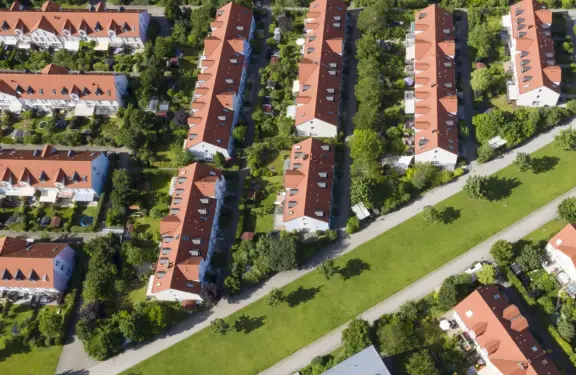
LEG Immobilien SE, based in Düsseldorf, provides a real-world example. The company relies on air-to-air heat pumps to provide sustainable heating for part of its housing portfolio in North Rhine-Westphalia.
The goal: to decarbonize the housing stock while keeping costs under control. To this end, LEG has established the joint venture dekarbo to oversee the retrofitting process.
By using renewable energy and air-to-air heat pumps, CO₂emissions during operation can be reduced by up to 100%. This project demonstrates how a sustainable modernization of building systems in the housing sector can be achieved in a cost-effective and future-proof manner.

A Compact Solution for Modern Building Systems: Installation and Operation
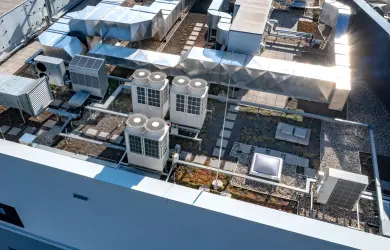
The floor plans of the apartments, ranging from 39 to 80 m², allow for the use of space-saving wall-mounted units that can be installed above doors. Three to four indoor units can be connected to a single outdoor unit, which is mounted on the building’s exterior or at ground level.
The bathrooms are heated separately using direct electric heating systems. Hot water is provided locally via electric storage water heaters or instantaneous water heaters.
Since LEG has standardized the transition from existing heating systems to air-to-air heat pumps, the retrofit can be scaled up. This makes it possible to modernize entire neighborhoods and apartment complexes in a short period of time. Starting in 2027, several thousand residential units are expected to be equipped with air-to-air heat pumps each year.
Economic Benefits and Government Incentives
Air-to-air heat pumps from Mitsubishi Electric offer state-of-the-art efficiency and achieve high SCOP values in heating mode. They are recognized by the Building Energy Act as a compliance option and may be eligible for federal subsidies for energy-efficient buildings.
Companies and property owners thus benefit from a solution that combines technical efficiency, relatively quick installation, and eligibilityfor subsidies. The specific subsidy options should always be evaluated on a project-by-project basis.

Assess the potential for renovation
Check potentialLet's work together to find the right solution for your portfolio
Would you like to know if air-to-air heat pumps are suitable for your housing stock? Our experts will help you find the right solution for your project—from the initial assessment to the detailed planning phase.