Air-to-air heat pumps
Benefits, function, costs, and product recommendations
ProduktreiheWith an air-to-air heat pump, you can install a particularly efficient heat pump system in your home. The high efficiency values are achieved by transferring the heat directly to the room air—without a "detour" via a heat distribution system, such as a radiator or underfloor heating. Another major advantage is the simple and quick installation – without any complex construction work on or in the building.
Since the air-to-air heat pump is a self-sufficient system, it does not need to be connected to the existing heating system. As a supplementary system, air-to-air systems reduce the consumption of other energy sources and thus significantly lower the costs for gas or oil. The conversion to the system can be carried out in stages, which means that no one-time large investment is required.
Additional benefits
With an air-to-air heat pump, you also combine the advantages of an air conditioning system with those of a heat pump. Technically speaking, a modern split air conditioning system is an air-to-air heat pump that can both cool and heat thanks to a switch valve. In addition, the air-to-air heat pump dehumidifies rooms in cooling mode, which prevents mold growth, and offers an integrated air filter that makes pollen, fine dust, and even viruses a thing of the past in your living spaces.
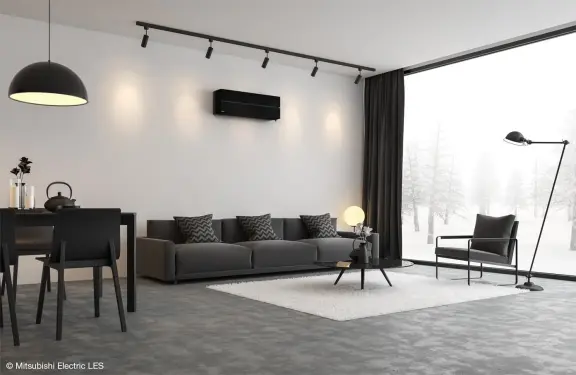
Our MSZ-LN devices from the M series also feature the innovative 3D i-see sensor: it detects people in the room and intelligently directs the airflow according to your preferences without creating drafts. Last but not least, an air-to-air heat pump with a modern design is sure to impress—bulky radiators are a thing of the past. And, of course, it offers the great advantage of keeping your home pleasantly cool in summer.
- Air-to-air heat pumps - Product recommendations
- How does an air-to-air heat pump work?
- Webinar: HEATING WITH AN AIR-TO-AIR HEAT PUMP – Video
- Costs of air-to-air heat pumps
- Which device combinations make sense for me?
- Finding the right specialist company
- Not all air-to-air heat pumps are the same.
- FAQs about air-to-air heat pumps
- Heating during the transition period:
- Find specialists and contact persons in your area
You can find more Mitsubishi Electric heat pump systems in our heat pump overview.
Air-to-air heat pumps - Product recommendations
products
Mitsubishi Electric M Series
Our multi-award-winning M series offers all the advantages of modern air-to-air heat pumps: with SCOP values of up to 5.2 and energy efficiency classes of up to A+++, it delivers maximum energy efficiency and can be used in outdoor temperatures as low as the low double digits. They also feature highly effective filter technology, smart control via the MELCloud app, whisper-quiet operation, and an innovative 3D i-see sensor for smart airflow control.





How does an air-to-air heat pump work?
FunctionFunctionality
Like any split air conditioner, every air-to-air heat pump consists of an outdoor unit and at least one indoor unit. The outdoor unit is always located outside the apartment or house. Depending on the requirements and the number of rooms to be heated or cooled, there are two variants: the single split variant for one room or the multi split variant for several or particularly large rooms. The technology behind air-to-air heat pumps is based on a closed refrigeration cycle, similar to that used in a refrigerator. Put simply, a room is heated by absorbing heat energy from the outside air and transferring it to the interior. In cooling mode, the refrigeration cycle is reversed and the heat pump functions as an air conditioner.

Webinar: HEATING WITH AN AIR-TO-AIR HEAT PUMP – Video
video recordingMissed the ONLINE SEMINAR? NO PROBLEM, YOU CAN FIND THE VIDEO RECORDING HERE
Alternative forms of heating to traditional gas or oil heating are currently in high demand. Air-to-water heat pumps or brine-to-water heat pumps are usually the first to be mentioned. Somewhat less familiar is the air-to-air heat pump, which is easy to retrofit and offers a wide range of advantages.
In the recording of our online information seminar, you can find out more about whether the switch is worthwhile and what points should be considered.
 Digital Knowledge Days Online Information Seminar
Costs of air-to-air heat pumps
expensesAcquisition and electricity costs
Acquisition costs: Air-to-air heat pumps are cheaper to purchase and install than air-to-water or geothermal heat pumps. This is mainly because they do not require any complex earthworks or drilling, as is the case with geothermal heat pumps. Since air-to-air heat pumps are a self-sufficient system and do not need to be connected to the existing heating system, there are also no costs for extensive renovation work.
Electricity costs: Air-to-air heat pump systems do not use electricity directly for heating, but only as drive energy. Most of the energy for space heating is obtained from the ambient air—even at low outdoor temperatures. An air-to-air heat pump typically generates around 4-5 kWh of heat per 1 kWh of electricity. Air-to-air heat pumps are therefore characterized by high energy efficiency.
Good to know: If you use air-to-air heat pumps as a fully-fledged heating system, you will receive the same subsidies under the BEG subsidy program (Federal Subsidy for Efficient Buildings) as you would for water-based heat pumps.
Which device combinations make sense for me?
combinationsWhat power do I need?
When choosing the right air-to-air heat pump, the required heating or cooling capacity must first be calculated. To do this, the heating requirements of the room in question must be determined. Factors such as the condition of the building envelope, room size, the intensity of solar radiation, and the type of use of the room in question are taken into account. Before purchasing, contact a specialist company that can provide a precise and reliable calculation.
Air-to-air heat pump split units
The number of rooms you want to heat or cool is the deciding factor when choosing between single and multi-split systems. Single-split systems consist of one indoor unit and one outdoor unit. They are useful if you only want to heat a single room, such as a newly converted attic.
With multi-split systems, on the other hand, up to 8 compatible indoor units of your choice can be connected to a single outdoor unit. Multi-split is therefore suitable for multiple or large rooms. Your specialist dealer will of course advise you on this as well.

Which indoor unit do I need?
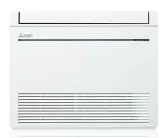
The indoor units available are mainly wall-mounted units and chest units, which can be combined with each other in multi-split systems. Cassette units are ideal for integration into suspended ceilings. When choosing an indoor unit, it is also important to consider which additional features are important to you, which filter classes you prefer, and which shapes and colors suit your home.
Which outdoor unit do I need?
With single split systems, the right outdoor unit for you depends directly on the choice of the corresponding indoor module. With multi split systems, it is primarily the required output and the number of indoor units that are connected that are important.
- best efficiency of all heat pumps
- short installation times
- rapid availability
- low investment costs
- Heating, cooling, dehumidifying, and air filtering
Finding the right specialist company
Finding the right specialist companyReliable planning, installation, maintenance, and servicing
Even the highest-quality air-to-air heat pump is only as good as its planning, installation, maintenance, and servicing. That is why we place great importance on trusting, fair, and long-standing partnerships with qualified specialist companies. We support our partner companies with all the latest technical documentation and provide professional training on our systems. This enables us to ensure that your specialist company finds the heating and air conditioning solution that you will enjoy for many years to come.
Download the checklist with questions for your meeting with your specialist company from the tile below. This will ensure you are well prepared for the meeting!
Not all air-to-air heat pumps are the same.
Climate expert explains
Our climate expert explains
We asked our expert, refrigeration engineer Thomas Miles, about the latest alternatives to gas heating. In our interview, he explains when he recommends an air-to-air heat pump for heating and what quality features to look out for.
FAQs about air-to-air heat pumps
Frequently Asked QuestionsNo, an air-to-air heat pump is a self-contained system that cannot be used to heat water. Either the existing heating system can (continue to) perform this task, or domestic hot water can be heated using instantaneous water heaters, for example.
An air-to-air heat pump is ideal for older buildings, especially if you don't want to undertake any major renovations such as installing underfloor heating. It can be used efficiently as a heating system, particularly in well-renovated and insulated existing buildings.
Instead of traditional radiators, air-to-air heat pumps use modern wall-mounted units, chest units, or ceiling cassettes. You only need radiators if you use the air conditioning system in addition to your existing heating system. However, there is no connection between the air-to-air heat pumps and this system.
Follow-up costs arise only from professional maintenance and filter replacement for your air conditioning system. How often this should be done in the best case scenario depends, among other things, on the frequency of use. It is best to consult with the specialist company that installed the system. They will be happy to advise you.
With a sound pressure level of up to 19 decibels at a distance of one meter from the unit, Mitsubishi Electric offers one of the quietest air-to-air heat pump systems on the market at the lowest fan speed. Your ears perceive this noise level as even quieter than the sound of leaves rustling in the wind. The devices are therefore virtually silent and ideal for heating and cooling bedrooms, for example. When the LowNoise function is activated, the sound level is reduced by a further 3 dBA.
You can efficiently heat up to eight rooms with an air-to-air heat pump in a multi-split system. Of course, it is also possible to supply even more rooms with heat. In this case, we recommend using several multi-split systems or larger air-to-air heat pumps that are designed for use in apartment buildings or commercial properties.