

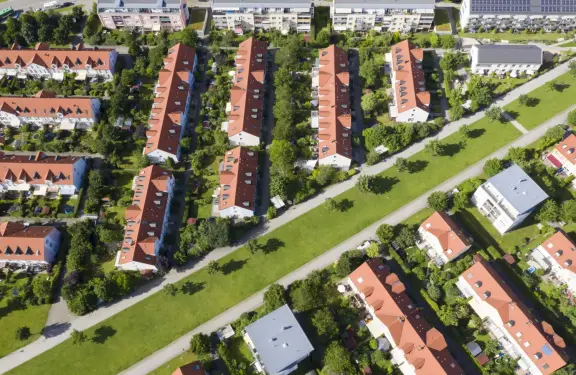
Heat pumps for apartment buildings
Solutions for the housing industry
New solutionsThe energy transition poses major challenges for owners of apartment buildings and housing associations:
There are around 41 million residential units in Germany, of which 22.6 million are in multi-family buildings. Around 4 million of these apartments are supplied with gas heating, with decentralized heat supply being particularly widespread in North Rhine-Westphalia. Due to the often advanced age of the heating systems and their poor energy efficiency rating, the heating output required here is particularly high.
In other words, there is a great deal of potential for optimization in terms of energy efficiency, particularly in the area of multi-family homes. The question is: What is the quickest and easiest way to exploit this potential?
The answer is: with heat pumps. Find out how heat pumps can replace central and decentralized heating systems in apartment buildings.
- Heat pumps as an economical and convenient solution
- Status quo of the heating landscape in Germany
- Government subsidies for heat pumps
- Air-to-air heat pumps for decentralized heating systems
- Heat pump solutions for central heating systems
- Our expertise for your project
- Important information about municipal heat planning
- Our references
Heat pumps as an economical and convenient solution
Efficient heating, smart cooling
In the housing sector, the advantages of a heat pump quickly pay off in many ways. Property managers become independent of district heating and also benefit from significantly improved energy efficiency. Thanks to the use of natural heat sources such as outside air, heat pumps are highly efficient, which in turn significantly reducesCO2 emissions. This means you automatically comply with legal requirements for heating and also offer your tenants greater comfort. After all, an air-to-air heat pump not only provides rapid heat, but also offers the possibility of effectively cooling rooms during the hot summer months. A real comfort bonus for tenants.

Status quo of the heating landscape in Germany
Figures. Data. Facts.Government subsidies for heat pumps
BEG fundingBEG funding for residential buildings
In addition to these comfort benefits and sustainable advantages, there is another: anyone who decides to install a heat pump can expect attractive subsidies.
Outdated heating systems, excessive CO2 emissions: To encourage more and more building owners to switch to sustainable heating solutions, the Federal Funding for Efficient Buildings (BEG) program offers attractive incentives for the use of new, efficient heat generators.
Anyone who uses renewable energies for heat generation as part of a residential building modernization project can expect to receive substantial subsidies. Up to €30,000 is available for the first residential unit.
Are all heat pumps eligible for subsidies?
No. In addition to high efficiency, passing a test conducted by an independent institute is also crucial for receiving funding. If a heat pump meets all the requirements, it is added to the BAFA's list of tested heat pumps. Many of our air-to-air heat pumps are also listed here.
Would you like to learn more about the legal requirements and find out what funding opportunities are currently available? Here you will find everything you need to know to stay up to date on the latest laws and government subsidies.

Air-to-air heat pump
Air-to-air heat pumpThe efficient and fast solution for decentralized heating systems
In the case of a decentralized heated existing property, the decentralized air-to-air heat pump is a particularly promising and also inexpensive solution.
Quick to install, conversion is also easy to carry out in inhabited buildings.
Combination of air-to-air heat pumps and instantaneous water heaters
A holistic solution is provided by combining air-to-air heat pumps with a continuous-flow water heater for hot water production. Here, the multi-split units of the M-Series MXZ provide the desired room heat, while continuous-flow water heaters or boilers supply the hot drinking water. As far as indoor units are concerned, various designs are available, from ceiling cassettes to wall-mounted and chest units.

Air-to-air heat pump – how it works:
The outdoor unit of the heat pump extracts heat from the ambient air and transfers it to a refrigerant, which transports the heat into the apartments. The indoor units then distribute the heat provided by means of active circulation in the room. That's it in a nutshell. If you would like more detailed information on how the heat pump works, simply follow the link.
Heat pump solutions for central heating systems
Heat pump solutionsIncludes domestic hot water supply
Ecodan air-to-water heat pumps are a powerful and sustainable solution for central heating systems. With Ecodan, up to six units can be cascaded, achieving a total output of up to 84 kW. R32 and R290 (propane) are used as future-proof refrigerants. Central domestic hot water preparation is possible with or without a fresh water station.
In addition, system efficiency can be increased in combination with special fan coil units for heat pumps, which look like modern radiators. As an alternative to underfloor heating, which cannot always be retrofitted, they ensure pleasant heat transfer by combining convection and radiant heat in a single device. Available in various compact sizes, they enable quick replacement of old radiators for any requirement.

External heating system – if there is no boiler room
Switching from a fossil fuel-based heat supply to a central supply with heat pumps poses specific challenges. These include, among other things, limited space for the use of heat sources. Another challenge is the high cost that such a conversion can entail. At the same time, the heating of domestic hot water must also be taken into account.
But we have a solution for this too: for serial renovation in the housing industry, our cooperation partner—PreFab TGA GmbH —offers external heat pump heating centers that are preconfigured with Ecodan heat pump cascades (with 4 or 6 units as standard) and delivered ready for easy installation on site.
This heating system makes it quick and easy to replace old fossil fuel heating systems, even in occupied buildings and where there is no boiler room. An elegant and intelligent solution for a customized, sustainable heating concept for multi-story residential buildings.

Central heating systems with domestic hot water preparation
Heat pump solutionsLarge heat pumps are a good option as a centralized solution. In buildings with high domestic hot water requirements, such as apartment buildings, dormitories, or sports facilities, two of these solutions can ideally be used:
The QAHV hot water heat pump and the EW-HT series high-temperature heat pump. Both systems generate large quantities of hot water, using different technologies.
The QAHV heat pump is a device that uses the natural refrigerant R744 ( CO2) and is specifically designed for the supply of hot drinking water in the housing industry and in commercial and industrial applications with high hot water requirements. Even at outdoor temperatures as low as -25 °C, the heat pump achieves water temperatures of up to 90 °C. In a cascade with 16 units, an output of 640 kW can be achieved.
In heating systems or for the production of domestic hot water, where high temperatures are required, water-to-water heat pumps such as the EW-HT series serve as boosters to raise an existing temperature level to the required demand. The EW-HT series from Climaveneta, which operates on the basis of the refrigerant R513A, uses an existing heat source as an energy source, cools it, and makes the extracted heat available to a consumer circuit with a high temperature level.
From consulting to support after the project ends:
Support for your projectBenefit from our 360º service
Renovating a single-family home is challenging enough. But anyone who wants to make several apartments or houses energy-efficient for the future faces a complex task and a wide variety of options.
- Configuration, system diagram, concepts for heat pump systems
- Consideration of environmental and financial aspects
- Concepts for renovation and existing buildings
- funding opportunities
- Support with tendering for services and approvals
- property management
- Support during commissioning
Please feel free to contact us
We look forward to working with you to drive forward the energy transition in real estate portfolios. With Mitsubishi Electric, you benefit from the best possible support right from the start:
- Control technology for all systems
- Monitoring existing interfaces and systems
- Nationwide customer service
- Comprehensive training network with extensive training offerings
- Service and maintenance for large heat pumps

Looking for a temporary solution? No problem.
MELRent rental solution
Whether it's construction delays or a lack of capacity at the utility company:
Sometimes the district heating connection is not available as planned. Nevertheless, the heat supply to tenants must continue—ideally without having to make large investments in a temporary solution. MELRent offers a suitable solution here. Mitsubishi Electric's flexible rental service provides heat pumps and air conditioning systems on a temporary basis. Fast, flexible, and without large investments.
Important information about municipal heat planning
Municipal heat planningClimate protection is one of the greatest challenges of our time. New approaches are needed, particularly in the area of heat supply. After all, heat supply accounts for more than 50 percent of total final energy consumption in Germany and causes a large proportion ofCO2 emissions.
Almost half of the approximately 41 million households are still supplied with gas and just under a quarter with heating oil. To change this, many laws have already been introduced and measures developed. One of these is municipal heat planning.
Municipal heat planning – an overview of the most important data:
Municipal heat planningThe Heat Planning Act
The Heat Planning Act regulates by when the heat plans must be drawn up in the federal states:
- By June 30, 2026: All municipalities with more than 100,000 inhabitants
- By June 30, 2028: All municipalities with fewer than 100,000 inhabitants
At the same time, the Heat Planning Act also specifies the deadline by which heating networks must be supplied from renewable energies and unavoidable waste heat:
- From March 2025: New heating networks must achieve a share of 65% renewable energy
- By 2030: Existing heating networks must reach a share of 30%.
- By 2040: Existing heating networks must achieve a share of 80% renewable energy.

