
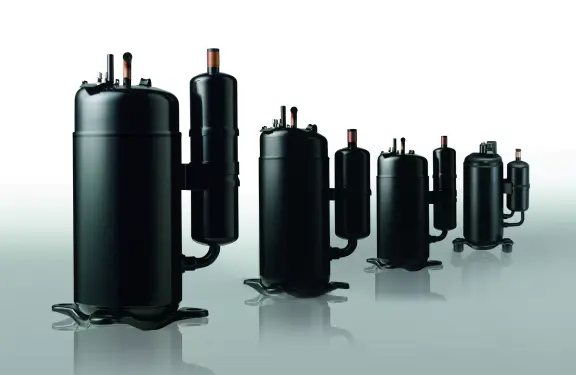
Refrigerant compressors
Refrigerant compressors for heat pumps and air conditioning systems
Product seriesScroll and rotary piston compressors
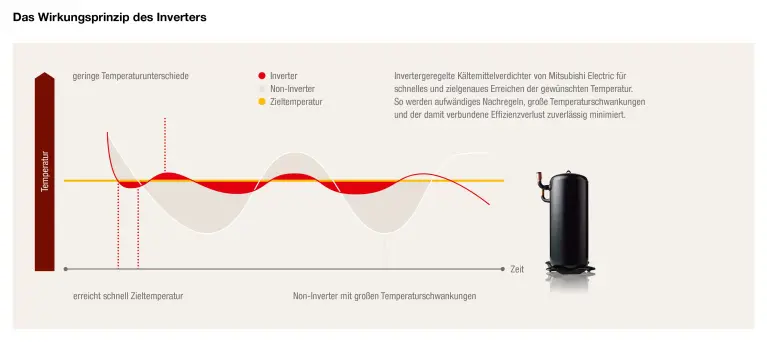
Mitsubishi Electric has decades of experience in manufacturing fully hermetic scroll and rotary compressors, which are equipped with state-of-the-art inverter technology, among other features. These are used as central components in our heat pumps and air conditioning systems. There, the compressor has the task of compressing the gaseous refrigerant and thereby heating it up significantly—a crucial step in the refrigerant cycle.
In addition, our compressors are also available as individual components for industrial series production. We live up to our claim of being the technological market leader by developing new series, continuously refining existing series, and implementing the latest technologies. In doing so, we rise to the growing demands of the European market every single day.
scroll compressor
Structure and functionThe scroll compressor usually consists of two interlocking screws. While one is fixed in place, the other moves eccentrically in circles. This creates several gas chambers between the screws, which become smaller and smaller towards the inside of the component. During operation, refrigerant enters the compressor via the low-pressure side. The gaseous refrigerant flows inwards between the screw walls, with the increasingly smaller space causing an increase in pressure. Once it reaches the center, the scroll compressor pushes the gases through a hole into the connected pipe.
Innovation: Frame Compliance Mechanism (FCM)
The globally patented Frame Compliance Mechanism (FCM) is particularly notable in that the Mitsubishi Electric scroll compressor has a (vertically) movable frame (= compliance frame) in addition to the conventional movable circular scroll screw. The movement of the frame is automatically adjusted by the prevailing pressures in the two pressure chambers. The pressure in the first chamber moves the frame and scroll screw upwards, while the pressure in the second chamber automatically adjusts to the optimum contact pressure. Thanks to this optimum independent adjustment, the FCM mechanism can minimize leaks while also minimizing mechanical friction losses.

Advantages of the Frame Compliance Mechanism
Frame compliance mechanismThis is achieved through the pressure-optimized adjustment of the scroll screws and the resulting higher performance in terms of preventing leaks while simultaneously reducing mechanical friction losses.
This results from lower mechanical wear and automatic lubrication. Automatic lubrication is achieved by the pressure difference within the compressor between the high-pressure and low-pressure sides, which causes the oil to flow from the high-pressure to the low-pressure side without the need for additional equipment such as an oil pump.
This results from frame compliance technology, whereby the pressure acting within the scroll screws is adjusted to the optimum value in such a way that disruptive contact between the scroll screws is reduced. The scroll compressor can thus ensure quieter operation.
Pressure-controlled lubrication allows the compressor to operate smoothly even at varying speeds. From very low to very high speeds, the lubrication automatically adjusts to the prevailing pressure conditions. This is a perfect solution, especially for speed-controlled compressors.
Scroll compressors from Mitsubishi Electric
scroll compressor
Features at a glance:
- Wide power range
- Compact design
- Frame Compliance Mechanism (FCM)
- High efficiency
- Low noise level
- Low vibrations
- Optimized scroll screw for use in heat pump applications
- Special compressor oils, optimally matched to the various refrigerants
- State-of-the-art BLDC motor technology for speed-controlled
rotary piston compressor
Structure and functionA rotary piston compressor is a compressor in which the piston rotates completely. Rotary piston compressors are therefore also known as rotary or circulating compressors. The refrigerant is compressed in a closed cylinder, on the inner wall of which an eccentrically mounted circular cylinder rolls. The suction and pressure sides are separated by slides in the cylinder, which means that no valves are required. Compressors of this type are therefore very efficient, comparatively quiet, and less prone to failure.

Rotary piston compressors from Mitsubishi Electric
rotary piston compressor
Features at a glance:
- Wide power range
- High efficiency
- Low noise level
- Low vibrations
- Special compressor oils, optimally matched to the various refrigerants
- Compact design
- Low "dead volume"
- Non-speed-controlled and speed-controlled compressors