
What are Modbus adapters in heat pumps?
Easy system integration with smart communication adapters
FAQ 02.11.2023The heat pump system is integrated into the superordinate building management system with the help of the Modbus or MelcoEcodan Smart Control adapter.
The adapters are connected to the storage or hydraulic module of an individual system or to a heat pump cascade and act as an external interface to the building management system.
The Modbus adapter can be used to connect the heat pump system to a house management system, for example. This means that the output of the air-to-water heat pump can be immediately adjusted in line with the current heat demand while taking into account the building requirements.
Our Modbus Adapter: MelcoEcodan Smart Control
Definition & FunctionHeat Pump - Smartly Integrated
The MelcoEcodan Smart Control universal communication adapter enables remote control of an Ecodan heat pump or cascade system via a higher-level control system. Depending on the system configuration, the heat pump’s key functions (on/off, heating/cooling mode selection, room or flow temperature setpoint) can be easily operated via the building management system (BMS).
 Modbus Communication Adapter
Integration of the heat pump system into the superordinate building management system
Integration into the Building Management System (BMS)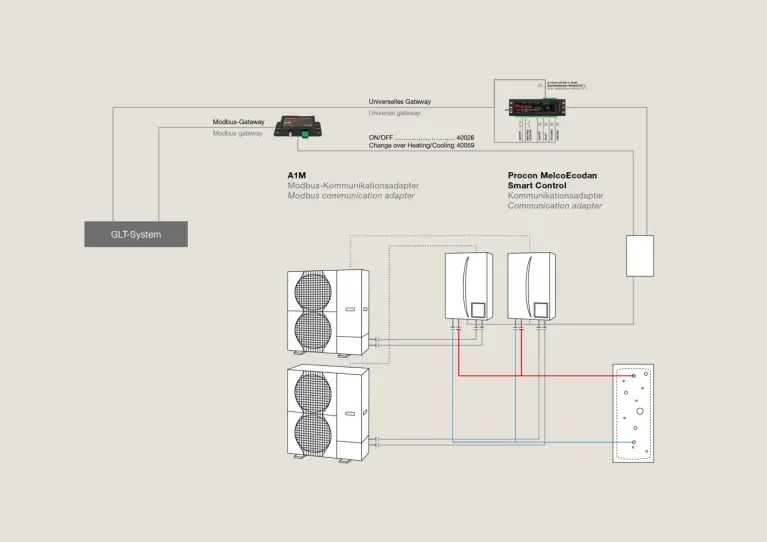
Heat Pumps from Mitsubishi Electric
ProductsModern Systems for Heating and Hot Water
Solutions for space heating and hot water at all times. Our high-quality heat pumps work reliably to always provide sufficient energy for heating and hot water.
From new buildings to renovations and for private, commercial and industrial applications alike, we have the right heat pump solution for you.
Modbus Adapters for Heat Pumps
FAQA Modbus adapter is a communication interface that allows a heat pump to be integrated into a higher-level control system. With Mitsubishi Electric, the Modbus or MelcoEcodan Smart Control adapter enables an Ecodan heat pump or a heat pump cascade to be connected to a building management system (BMS) or a compatible home management system. Depending on the interface used, communication takes place via the Modbus protocol or via the designated connection to the higher-level control system.
The adapter is used when heat pump operating data needs to be recorded centrally or when core functions need to be controlled via a higher-level control system. This is particularly useful in larger buildings, commercial applications, multi-story residential buildings, or when operating heat pump cascades, in order to coordinate heat generation with other building systems.
The interface allows you to control key functions of the Ecodan heat pump. Depending on the system configuration and the programming of the building management system, these functions include turning the system on and off, switching between heating and cooling modes, and setting setpoints for room or supply water temperature. Depending on the scope of the interface, status information and system messages can also be used for central system monitoring.
Yes, integration is also possible with an Ecodan heat pump cascade. The adapters are connected to the storage tank or hydromodule, or to the cascade control system. This allows the cascade to be integrated into the building management system’s overarching control structure.
This integration offers the potential to better coordinate the heat pump’s operation with the building as a whole. This allows the air-to-water heat pump’s output to be adjusted more flexibly to actual heating demand. While this supports demand-based operation, it does not replace proper sizing, hydraulic balancing, and on-site commissioning of the system.
No, a Modbus adapter is not required for standard heat pump operation. The Ecodan systems already have their own system control. A Modbus adapter is only necessary if you want to integrate the system into a higher-level building management system, an external control system, or a central monitoring system.
The design and integration should be carried out by qualified specialized contractors, system integrators, or specialist planners for building services engineering (TGA). It is important that the building management system parameters be aligned with Mitsubishi Electric’s interface specifications to ensure reliable communication and to guarantee that the heat pump operates within the intended system limits.