Hotel air conditioning with Hybrid VRF technology
Setting the trends compliant to standards
Professional article 09.10.2025There are few other properties that gather as many different rooms with various climate zones under one roof than hotels. As a specialist planner, you must cover the many and varied complex requirements for ventilation and air conditioning technology in your hotel planning. Hybrid VRF technology was specially developed for flexible yet future-oriented and sustainable planning of buildings with high efficiency and comfort requirements. To this end, it combines the assets of VRF systems with those of water-based system solutions.
- Simultaneous or alternating cooling and heating
- High energy efficiency
- Significantly reduced refrigerant charge amount
- Wide range of indoor units
- No refrigerant in indoor spaces
VRF or Hybrid VRF technology
Building technology for the futureThe globally unique Hybrid VRF system combines the assets of a VRF system with those of a water-based system. There are basically two series available to you for planning: With the R2 series, you heat and cool simultaneously – with the Y series, you can choose between heating and cooling. In hotel operations, the Hybrid VRF R2 systems score particularly well: They allow hotel guests to regulate the temperature in each room according to their own preferences and decide whether the room should be supplied with cooling or heat.
An HVRF system essentially consists of a VRF R2 outdoor unit – the City Multi series – and a specially designed hybrid BC controller, which ensures that the temperature required by hotel guests is available at each indoor unit. Another advantage over VRF systems is that the refrigerant circulates exclusively between the outdoor unit and the Hybrid BC controller or the hydro unit. Water is the only energy carrier used within the building itself.

Standard-compliant planning for the future
With an HVRF, you can kill two birds with one stone in terms of standards compliance: Hybrid VRF technology enables usersto enjoy all the benefits of a VRF systemin compliance with standards even when using R32 refrigerant. As the refrigerants are not used indoors, there are no refrigerant pipes running through the hotel rooms. This means that the F-Gas regulation (DIN EN 378 or IEC 60335) does not even come into play in individual rooms. By using the refrigerant R32, the CO2 equivalent as required by the EU for 2030 can already be achieved today.

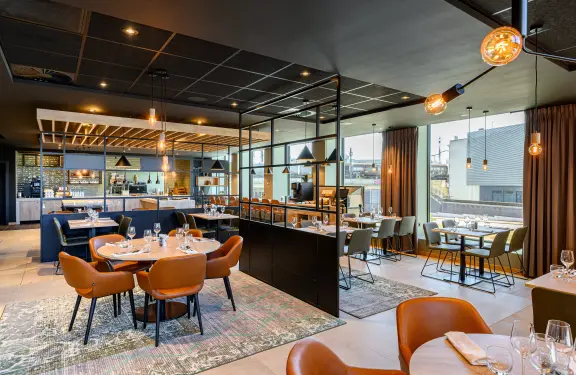
Best Practice: Hybrid VRF technology with water-cooled VRF outdoor units for indoor installation in the Stadthotel Haslach
Planning requirements: It should be possible to comply with the regulations of the building specification and of DIN EN 378 by using fewer outdoor units. In addition, depending on local building regulations, it may also be a requirement that outdoor units of air-conditioning systems should not be visible when installed on the roof of a building. At theStadthotel Haslachwater-cooled VRF outdoor units for indoor installation have been used as an alternative. In this particular case, a water well serves as source for the water cooling.
 Mitsubishi Electric HVRF technology in Stadthotel Haslach
All benefits for planners
Summary- Hybrid VRF technology allows the greatest possible flexibility in terms of use of space and floor plan as well as regarding the functional choice for users.
- It can be seamlessly connected to the higher-level building management system.
- All the necessary hydraulic components are already in place – pumps supply the indoor units with the necessary cold and hot water as required.
- Buffer vessels are not necessary thanks to the inverter technology.
- Only two pipes featuring a very small cross-section are required for simultaneous heating and cooling.
- This means that existing distribution structures in the building can be retained while still taking advantage of VRF technology efficiency benefits.