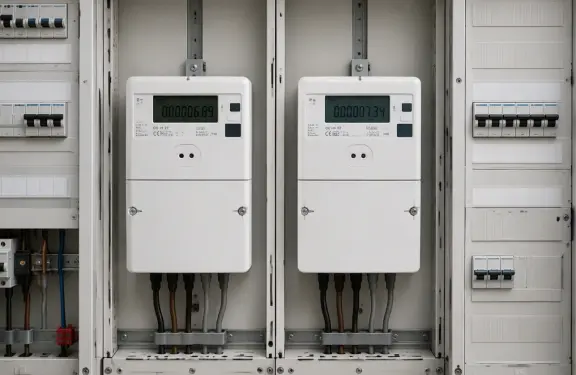
AI-generated
Smart Meters and Dynamic Electricity Rates
How Heat Pumps and Air Conditioners Take Advantage of Off-Peak Electricity Rates
Professional article 10.09.2026As renewable energy expands, the way electricity is generated and used is also changing. On sunny or windy days, there may be a large amount of electricity available at times. At other times, electricity generation is lower or demand is particularly high. Dynamic electricity rates take these fluctuations into account: The price of electricity is no longer the same throughout the day but is based more closely on the current market situation.
This creates a new incentive for consumers: to use electricity when it is available at a low price. This is particularly appealing for households and buildings with larger, flexibly controllable electrical appliances. These include, for example,heat pumps, air conditioners, battery storage systems, and wall boxes.
Heat pumps and air conditioning systems demonstrate how dynamic electricity rates can be put to practical use in everyday life. This is because they do not simply use electricity directly, but convert it into heat or cooling. Within certain limits, this energy can be time-shifted - for example, through a hot-water storage tank, the building’s mass, or proactive room temperature control.
- What are dynamic electricity rates?
- Smart Meters & Digital Electricity Meters: Differences
- Smart Meter Rollout and Heat Pumps
- Time-Varying Grid Fees and Section 14a of the German Energy Industry Act (EnWG)
- Heat Pumps and Dynamic Electricity Rates
- Air Conditioners and Dynamic Electricity Rates
- Energy Management System (EMS): A Complement to the Smart Meter
- Smart Grid-Ready: Heat Pumps & Air Conditioners
- Good to Know: Network Contributions and Funding
- Are you planning to install a heat pump or an air conditioner?
- FAQ
What are dynamic electricity rates?
Dynamic Electricity RatesWhen the price of electricity follows the market
With a standard electricity rate plan, customers typically pay a fixed rate per kilowatt-hour. The price remains the same regardless of whether electricity is particularly cheap or expensive on the market at the time.
A dynamic electricity rate works differently: The price of electricity can change throughout the day and tracks electricity market prices more closely. If there is a lot of electricity available from renewable sources and demand is low, the price may drop. If demand is high or there is less electricity available, the price may rise.
In order for a dynamic rate plan to be billed correctly, electricity consumption must be recorded at precise intervals. This requires a smart metering system that not only measures the total amount of electricity consumed but also trackswhen that consumption occurred.
Smart meters and digital electricity meters are often mentioned in the same breath—but technically, there are important differences between them.
Smart Meters & Digital Electricity Meters: Differences
Differences AI-generated
What Technology Makes Dynamic Electricity Rates Possible
In order to use a dynamic electricity rate plan and ensure it is billed correctly, electricity consumption must be recorded in real time and transmitted securely. This is exactly why a smart metering system is needed - a simple digital electricity meter alone is not sufficient.
A digital electricity meter measures electricity consumption electronically and displays the consumption readings digitally. In technical terms, it is also referred to as a modern metering device. However, the data is not automatically transmitted to the grid operator or electricity provider.
It is only when connected to a smart meter gateway that a smart meter - or an intelligent metering system - is created. The gateway handles secure communication and enables consumption data to be transmitted in real time. This technical foundation is essential for the use and billing of dynamic electricity rates in everyday life.
To help with classification, the most important terms can be clearly distinguished:
Meaning
Measures power consumption electronically, but does not automatically transmit the data
Secure communication unit for transmitting consumption data
Combination of a digital electricity meter and a smart meter gateway
Term
Digital electricity meter / modern metering device
Smart Meter Gateway
Smart Meter / Smart Metering System
Smart Meter Rollout and Heat Pumps
Smart Meter RolloutWhy Smart Metering Systems Are Becoming More Important for Flexible Consumers
Smart metering systems are particularly relevant in situations where large electricity consumers can be controlled flexibly. This includes heat pumps. Like wall boxes, battery storage systems, and room cooling systems, they are considered controllable consumption devices if they meet the appropriate technical requirements.
For such applications, it is crucial that consumption is not only measured but can also be better integrated into the electricity market and grid in the long term. To achieve this, heat pumps must be able to receive control signals and adjust their power consumption accordingly. This allows them to prioritize using electricity when it is available at a low cost or when a particularly large amount of renewable energy is being fed into the grid.
The provisions of Section 14a of the Energy Industry Act (EnWG) apply to newly connected controllable consumption devices in the low-voltage grid with a grid connection capacity of 4.2 kW or more. If there is an imminent risk of local grid overload, the grid operator may temporarily limit the power draw from the grid by the controllable consumption device. The rest of the household’s electricity is not affected by this. In return, operators receive a reduction in grid fees. Furthermore, the grid operator may not refuse or delay the connection of a new controllable consumption device solely on the basis of a potential local grid congestion.
However, the expansion of this infrastructure is proceeding gradually. According to the Federal Network Agency, 23.3% of the relevant mandatory installation cases were equipped with a smart metering system by the end of 2025. This includes mandatory installation cases with an annual electricity consumption of 6,000 to 100,000 kWh, including controllable consumption devices as defined in Section 14a of the Energy Industry Act (EnWG).
This shows that while the foundation for dynamic electricity rates, grid-optimized control, and flexible electricity use is in place, in practice it is still being developed in many areas. For homeowners, therefore, it is crucial to know when their household will receive a smart metering system and which rates will then make the most sense.
Time-Varying Grid Fees and Section 14a of the German Energy Industry Act (EnWG)
Time-Varying Grid Fees
Distinguish between two pricing signals for flexible electricity use
Two different time-dependent pricing signals can affect your electricity bill: A dynamic electricity rate reflects fluctuations in the electricity market. Time-variable grid fees, on the other hand, are based on time windows predetermined by the respective grid operator.
For controllable consumption devices, various pricing models are available under Section 14a of the Energy Industry Act (EnWG). As of April 1, 2025, grid operators must also offer a time-varying grid fee. This is combined with the flat-rate grid fee reduction.
It is important to note that favorable time slots for grid fees do not necessarily coincide with favorable electricity market prices. Which combination makes economic sense therefore depends on the rate plan, consumption, and the specific grid operator. An energy management system can help take different price signals into account when controlling flexible loads.
Heat Pumps and Dynamic Electricity Rates
Heat Pumps & Dynamic Electricity Rates
Take Advantage of Off-Peak Electricity Rates for Heating and Hot Water
Heat pumps are particularly well-suited for use with dynamic electricity rates. This is because they use electricity to generate heat for heating and hot water. This heat does not always have to be generated at the exact moment it is used.
A good example is hotwaterheating: When the price of electricity is particularly low during the day or your own PV system is generating a lot of electricity, the heat pump can bring the hot water tank up to the desired temperature. The hot water is then available later without the heat pump having to draw electricity again right away.
Heating also offers flexible options:
- During periods when electricity rates are low, the building can be easily preheated within comfortable limits.
- The building structure stores some of this heat.
- As a result, the heat pump does not have to work as hard during periods when electricity rates are higher.
For users, this means that livingcomfort is maintained while electricity consumption is distributed more intelligently. Proper planning and control are always key. The heat pump should not simply run as often as possible, but rather be integrated into the overall system efficiently and in accordance with demand.
Air Conditioners and Dynamic Electricity Rates
Air Conditioners & Dynamic Electricity RatesHow Predictive Cooling Can Take Advantage of Low-Cost Electricity Periods
Dynamic electricity rates aren't just useful for heating. Air conditioners can also help you use electricity more efficiently - especially when you plan your cooling in advance.
On hot summer days, alot of solar power is often generated precisely when the demandfor cooling increases. When combined with a smart meter and a dynamic electricity rate plan, it becomes easier to see when electricity is available at a lower cost. If a PV system is also in place, self-generated electricity can be used more strategically for cooling.
In practical terms, this means that rooms can be cooled earlier and at a more moderate rate, rather than only after they have already become very hot. The air conditioning system therefore does not have to work under heavy load to cool overheated rooms; instead, it can take advantage of off-peak electricity rates or its own solar power to proactively maintain a comfortable indoor climate. This preserves comfort while allowing electricity consumption to be distributed more efficiently.

Energy Management System (EMS): A Complement to the Smart Meter
Energy Management SystemHow Flexible Consumers Can Be Controlled Automatically
An energy management system, or EMS for short, is not a requirement for a dynamic electricity rate plan. However, it can make it easier to take advantage of low-cost electricity periods in your daily life.
While the smart meter records and transmits consumption data in real time, an EMS goes a step further: It can link various components in the building - such as heat pumps, air conditioning systems, photovoltaic systems, battery storage units, or wallboxes. This allows flexible loads to be operated more efficiently when electricity is available at a low cost or comes from the building’s own PV system.
For users, this means they don't have to constantly monitor electricity prices or manually control their devices. An EMS can help better balance consumption, generation, and comfort.
With MELCloud Home, you can easily control and monitor Mitsubishi Electric air conditioning and heat pump systems right from the app. This lets you keep track of temperature, operating times, and settings, and tailor your comfortable indoor climate to your daily routine.
Smart Grid-Ready: Heat Pumps & Air Conditioners
Smart Grid-ReadyWhy the Right Interfaces Are Important for Flexible Electricity Use
For heat pumps and air conditioning systems to make effective use of off-peak electricity rates, it’s not just a matter of having a smart meter and the right electricity rate plan. It’s also crucial that the technology used can be controlled and integrated into a smart energy system.
A suitable interface first establishes the technical prerequisites for the heat pump to receive external control signals and adjust its power consumption accordingly. However, the interface alone cannot detect dynamic electricity prices or current PV generation. For automatic optimization based on electricity prices, PV power, or time-varying grid fees, a suitable control or energy management solution is also required. The heat generated can be stored within certain limits, such as in a hot water tank or within the building’s mass.
When it comes to air conditioning systems or air-to-air heat pumps, it’s also worth taking a look at the technical interfaces. For Mitsubishi Electric’s M-Series units, grid connectivity can be achieved using the optionally available Smart Grid Adapter (RAC SG Adapter). Which combinations are suitable in a specific case should be evaluated during the planning phase.
In terms of planning and selection, this means: Anyone who wants to make greater use of dynamic electricity rates, solar power, or grid-friendly control systems in the future should have this assessed early on,
- whether the heat pump or air conditioner has the appropriate interfaces,
- whether accessories such as a smart grid adapter are required,
- whether integration into an energy management system is desired,
- and how comfort, efficiency, and controllability can be effectively combined.
In this way, the dynamic electricity rate becomes not just a pricing model, but a building block for a sustainable building concept.
Good to Know: Network Contributions and Funding
Good to Know
The term “smart grid-ready” is not only relevant in the context of dynamic electricity rates. Grid-friendly controllability can also play a role in the promotion of heat pumps.
The point is not that a dynamic electricity rate is a prerequisite for receiving subsidies. Rather, the decisive factor is whether the system has suitable interfaces that allow it to be integrated into a smart energy system and operated in a way that benefits the grid.
This applies to both traditional air-to-water heat pumps and eligible air-to-air heat pumps or air conditioning systems. Mitsubishi Electric’s Ecodan air-to-water heat pumps are designed for integration into a smart grid. For M-Series units, grid connectivity can be achieved using the optionally available RAC SG adapter.
The specific requirements that apply to a given funding case should always be reviewed during the planning and application process.
FAQ
FAQA dynamic electricity rate is a rate plan in which the per-unit price can change throughout the day. The price is more closely tied to current electricity market prices. As a result, electricity can be cheaper or more expensive at certain times.
Yes, a dynamic electricity rate plan requires a smart metering system. It records electricity consumption in real time, thereby enabling accurate billing. A simple digital electricity meter alone is not sufficient for this purpose.
No. A digital electricity meter measures electricity consumption electronically and displays the readings digitally. It is only when connected to a smart meter gateway that it becomes a smart meter—or an intelligent metering system. This system can transmit consumption data in real time.
An energy management system (EMS) is not a requirement for a dynamic electricity rate plan. However, it can make it easier to take advantage of periods when electricity rates are lower. To do this, it connects various components in the building, such as heat pumps, air conditioners, solar panels, battery storage systems, and wall boxes.
Heat pumps use electricity to generate heat for heating and hot water. This heat does not always have to be generated exactly when it is used. It can be stored within certain limits, for example in a hot-water tank or within the building structure. This allows for better use of off-peak electricity rates without compromising comfort.
Yes, air conditioners can also take advantage of off-peak electricity rates. For example, rooms can be cooled earlier and at a more moderate temperature, rather than waiting until they have already become very hot. This is particularly beneficial when you also have your own solar power available from a PV system.
"Smart Grid-Ready" means that a system can be integrated into a smart energy system via appropriate interfaces and can receive external control signals. However, the interface alone does not optimize operation based on current electricity prices or PV generation. This requires an additional suitable control or energy management solution.
No, a dynamic electricity rate is not automatically a requirement for receiving a subsidy. However, when it comes to heat pump subsidies, the ability to control the system for grid benefits may play a role. The specific requirements should always be checked for each individual subsidy application.
Heat pumps are among the larger, controllable electricity consumers in buildings. That is why smart metering systems play an important role in the further expansion of flexible electricity use. They provide the technical foundation for recording consumption in real time and, in the long term, for better integrating heat pumps into the electricity market and grid.
No. Savings depend on energy consumption, the rate plan, the building, and the existing technology. It’s especially worth looking into for homeowners if major appliances such as heat pumps, air conditioners, storage units, or wall boxes can be controlled flexibly—in that case, you can take better advantage of off-peak hours.