
Heat pumps for the Bilker Bunker
Energy-saving heat supply for a listed building
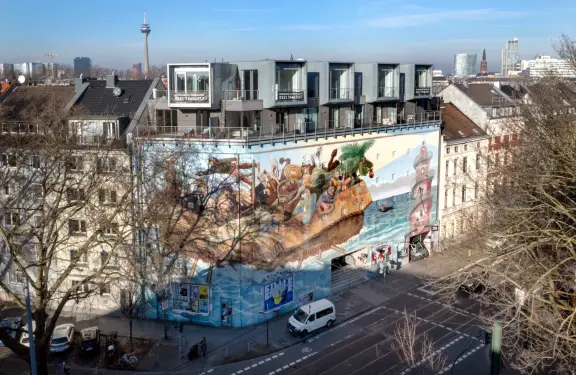
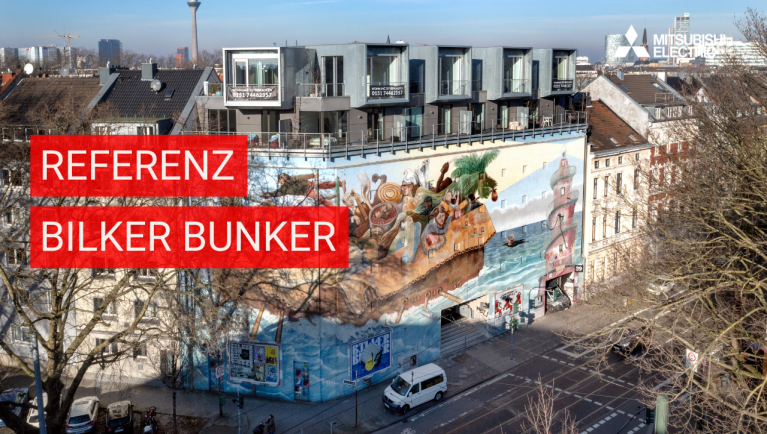
DüsseldorfBilk is Düsseldorf's most populous district and a popular place for students to live. Bilk is also known for its extremely diverse district culture with numerous restaurants, cafés, and cultural institutions such as the "Bilker Bunker." The building, which was constructed as air-raid shelter No. 25, was sold when its civil defense status was revoked and has been renovated over the past two years. The owner is KÜSSDENFROSCH Häuserwachküssgesellschaft mbH, a company that seeks out and purchases interesting, unusual buildings that are worth preserving and finds the right economic concept to ensure that these buildings are preserved for the cityscape and for future generations.
Do you also have an exciting project?
Please contact us.
Requirements:
- Comprehensive redesign of building services engineering
- Energy-saving and sustainable heat supply
- Pleasant and comfortable temperature level
- Controlled ventilation and air extraction
initial situation
initial situationIn the first phase, five maisonette apartments with a total DIN living space of 670 m² were built on the roof of the bunker. The high-quality apartments were sold as condominiums and range in size from 97 to 164 m². They are heated by underfloor heating and can also be cooled in summer using this system. In the second phase of construction, the original structure (bunker) was converted in accordance with monument protection regulations. In particular, wall openings were created in the interior to create transparency and permeability between individual rooms. In addition, some ceilings were removed and new steel beams were installed to allow larger objects to be displayed in the exhibition rooms. The conversion into an art and cultural space by Bilker Bunker gGmbH has created the "Bilker Bunker," a non-profit cultural institution that promotes social exchange through the medium of art, so that behind the meter-thick walls there is now an innovative space for art, culture, and leisure that is open to everyone.

project voice
project voice

As architects and project developers, we work very closely with citizens and administrations, striving to take the wishes of all parties into account. We plan and implement the renovation from design to completion, allowing us to influence every detail, no matter how small.
challenges
challenges
However, the majority of the heating requirements had to be covered by modern, forward-looking technology that meets today's demands on buildings with event, music, seminar, and office spaces. "The GEG's requirements for heating technology did not apply to the air-raid shelter due to its listed status. However, they did apply to the five apartments that were built on top of the bunker. A heating system based on fossil fuels was considered, but was quickly rejected due to the political circumstances," explains Peter Dukome, project manager at PBS-Energiesysteme GmbH in Haan.
Together with the specialist company Hass&Reuten Klimatechnik GmbH from Neuss, an optimal, acoustically optimized cascade solution from Mitsubishi Electric was found. "The property was and is of particular interest to us. Over two construction phases, a technically demanding project was completed in around five years," explains project manager Rolf Bijjou from the specialist company Haas&Reuten Klimatechnik GmbH.
The comprehensive redesign of the building services played a major role in the modernization and conversion of the bunker building. The building services challenge was to develop and implement an energy-efficient and sustainable heating system for this unusual and listed building in order to ensure a pleasant and comfortable temperature level throughout the year, both in the bunker area and in the apartments built on top of it, in accordance with GEG standards. The building's exterior shell, which is almost windowless for reasons of historic preservation, requires controlled ventilation inside the bunker. To this end, a new central ventilation unit and complete air ducts were installed.

project voice
project voice Managing Director Frank Schupke (left) and Project Manager Rolf Bijjou (right) // Photo: BWP / Bernd Lauter
In the first construction phase—the residential area—a 2-stage cascade was used for heating and cooling via surface heating. In the second construction phase—the exhibition area—a 4-stage cascade was installed for heating with radiators. Both systems have been running reliably and without disruption since commissioning.
solution
solutionFour Ecodan air-to-water heat pumps from Mitsubishi Electric are used in a cascade configuration to heat the bunker. Cascading the heat pumps offers numerous advantages over a single heat pump with a correspondingly high output. Cascades have a larger modulation range, which leads to more uninterrupted operation. Cascades are more efficient because the units run more efficiently (energy-saving) at partial load. The control system with auto-adapt function optimizes operating behavior and automatically searches for the best operating point in each case. In addition, a cascade offers a redundancy function for the maintenance of individual units and leads to increased operational reliability.
The cascade of four individual PUD-SHWM140YAA units, each with a rated heat output of 14 kW, provides heat for the old air-raid shelter. Divided into seven floors (two basement floors and five above-ground levels), the total area covers approximately 2,300m2, which is heated by heat recovery from the central ventilation system and the four air/water heat pumps. The heat pumps thus cover the heating load of the building in monovalent operation. Heat is distributed by finned tube radiators, which fit in well with the character of the bunker due to their raw steel appearance.


Optional heating or cooling with reversible heat pumps
Two reversible Ecodan air-to-water heat pumps of the type PUZ-SHWM120YAA from Mitsubishi Electric supply the new apartments built on the roof of the bunker as a two-stage cascade. The outdoor units each have a rated heating capacity of 12.1 kW and a cooling capacity of 12 kW and supply the underfloor heating systems with heat when outside temperatures are cold. During the hot summer months, the heat pumps are used to circulate cool water through the underfloor heating system. This surface temperature control indirectly cools the building structure when outside temperatures are high, with the result that the heat load is dissipated outside via the underfloor heating system and the rooms are cooled down by a few degrees.
Strong advantages
benefits100% performance at minus 15 °C thanks to patented Zubadan technology
Both the outdoor units for the bunker and those for the residential units are equipped with patented Zubadan technology. This makes it possible to keep the refrigerant mass flow and thus the compressor speed constant. To achieve this, a two-phase mixture is injected into the compressor head during the compression process. The flash injection cycle of the Zubadan compressor allows it to operate at a higher speed at low outdoor temperatures, while the amount of refrigerant in the heat pump system can be kept constant. This means that the heat pumps can still deliver 100 percent of their heating capacity even at very low outdoor temperatures of down to minus 15 °C. At the same time, the lower operating range is extended to an outside temperature of minus 30 °C, at which the heat pumps provide a temperature that can be used for heating. An electric heating element or additional heat generator is not required.
Outdoor units on the exterior facade
Due to local inner-city conditions, the outdoor units were installed on the exterior facade. The four-unit cascade is mounted on a ledge above the gate entrance. The two-unit cascade for the apartments was mounted on a platform on the third floor of the facade. Both locations are easily accessible for maintenance work, offer good air circulation, and are barely noticeable visually or acoustically. The heat pump cascades are hydraulically integrated into the various heat distribution systems via hydromodules, in which the energy is transferred from the refrigerant to the heating water.
Two buffer tanks expand the system
The indoor units for the four-stage cascade supplying the bunker are located in a technical room on the third floor. Each outdoor unit has a hydromodule with a heat exchanger unit. The system is supplemented by two buffer tanks that store the pre-conditioned heating water until it is needed and serve to bridge any periods when the power supply is cut off. At the same time, the buffer tanks always provide sufficient energy for defrosting the outdoor modules in winter. The technical room for the heat pump cascade for the five residential units is located on the fourth floor and has two hydromodules for energy exchange and a buffer tank for storing hot or, depending on the operating mode, cold domestic water.


The most important points
Summary- The former air-raid shelter in Düsseldorf Bilk has recently been converted into a cultural facility. In addition, five high-quality maisonette apartments have been built on the roof of the building.
- Six Ecodan air-to-water heat pumps from Mitsubishi Electric are being used to provide this unusual building, parts of which are listed, with an energy-efficient and sustainable heat supply.
- The Ecodan air-to-water heat pumps are designed as four-stage and two-stage cascade systems, with the four-stage cascade supplying the rooms in the bunker and the two-stage cascade heating or cooling the five new residential units.
- Ecodan air-to-water heat pumps are the optimal solution for implementing the new Building Energy Act (GEG), enabling energy-saving and efficient operation for heat supply and room cooling.
- All devices are equipped with patented Zubadan technology, which allows the heat pumps to deliver 100 percent of their heating capacity even at low outdoor temperatures of down to minus 15 °C.
- In order to provide a temperature suitable for heating, the lower operating range is simultaneously extended to an outside temperature of minus 30 °C.
- No electric heating element or other heat generator is required.
